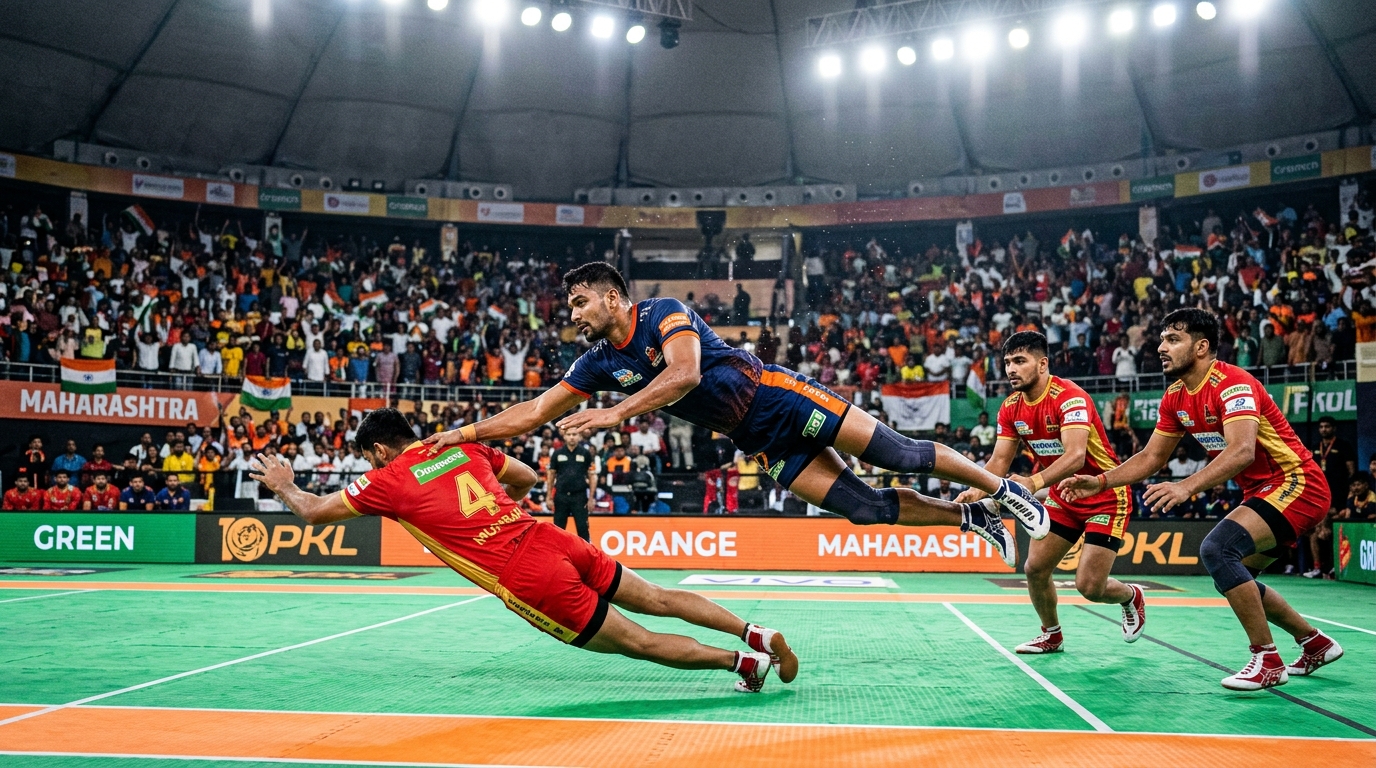
Technical Transition to High-Grip Synthetic Matting
Historically played on loose outdoor clay, modern competitive kabaddi mandates shock-absorbing synthetic EVA mats that protect joints during explosive lunges, ankle holds, and diving tackles.
Coaching academies across rural Kolhapur, Sangli, and Ratnagiri have retrofitted their taluka gymnasiums with certified competition mats, enabling young athletes to master specialized footwork without suffering abrasive friction burns.
Refined technical skills—such as the rapid 'toe-touch', rotational 'dubki', and synchronized corner chain defensive blocks—are now drilled under certified coaches.
Physiological Conditioning and Grassroots Scouting
State kabaddi associations have partnered with sports nutritionists to design high-protein dietary guidelines for adolescent players.
Talent scouts from domestic corporate leagues and state services monitored the championship matches, selecting forty promising teenagers for fully funded multi-year residential sports scholarships.
Operational Engineering and Metrological Telemetry: Field Metrics
Detailed field investigations conducted across Western Maharashtra reveal that rigorous standardization and telemetry protocols form the operational backbone of this initiative. Modern instrumentation and automated data loggers continuously monitor key operational variables, minimizing human error and providing real-time data feeds to regional command centers.
Under standard operational procedures, field technicians conduct periodic multi-point calibrations against certified reference standards. This continuous measurement feedback loop ensures that environmental, structural, and mechanical tolerances remain strictly within regulatory thresholds established by state monitoring boards.
Statutory Governance, Institutional Audits, and Workforce Compliance
Compliance frameworks governing these operations are strictly aligned with Maharashtra state guidelines and central statutory mandates. Regular third-party technical and environmental audits are performed by accredited engineering agencies to verify structural stability, workplace safety standards, and environmental mitigation protocols.
Furthermore, structured vocational training modules have been established for regional technical personnel, ensuring that operators and supervisory staff are fully qualified to maintain advanced equipment without external dependency. This institutional capacity building represents a critical asset for long-term operational resilience.
Socio-Economic Multipliers and Regional Development Horizons
Beyond immediate operational and infrastructure dividends, the initiative provides substantial economic multipliers for surrounding communities. Local manufacturing workshops, specialized material suppliers, and maintenance technicians experience direct commercial growth through supply-chain formalization.
Community representatives and regional industry associations emphasize that continued state capital investment in these modernized systems fosters long-term civic stability. By bridging traditional craftsmanship with precision engineering, the project establishes a robust benchmark for sustainable regional advancement across Western India.