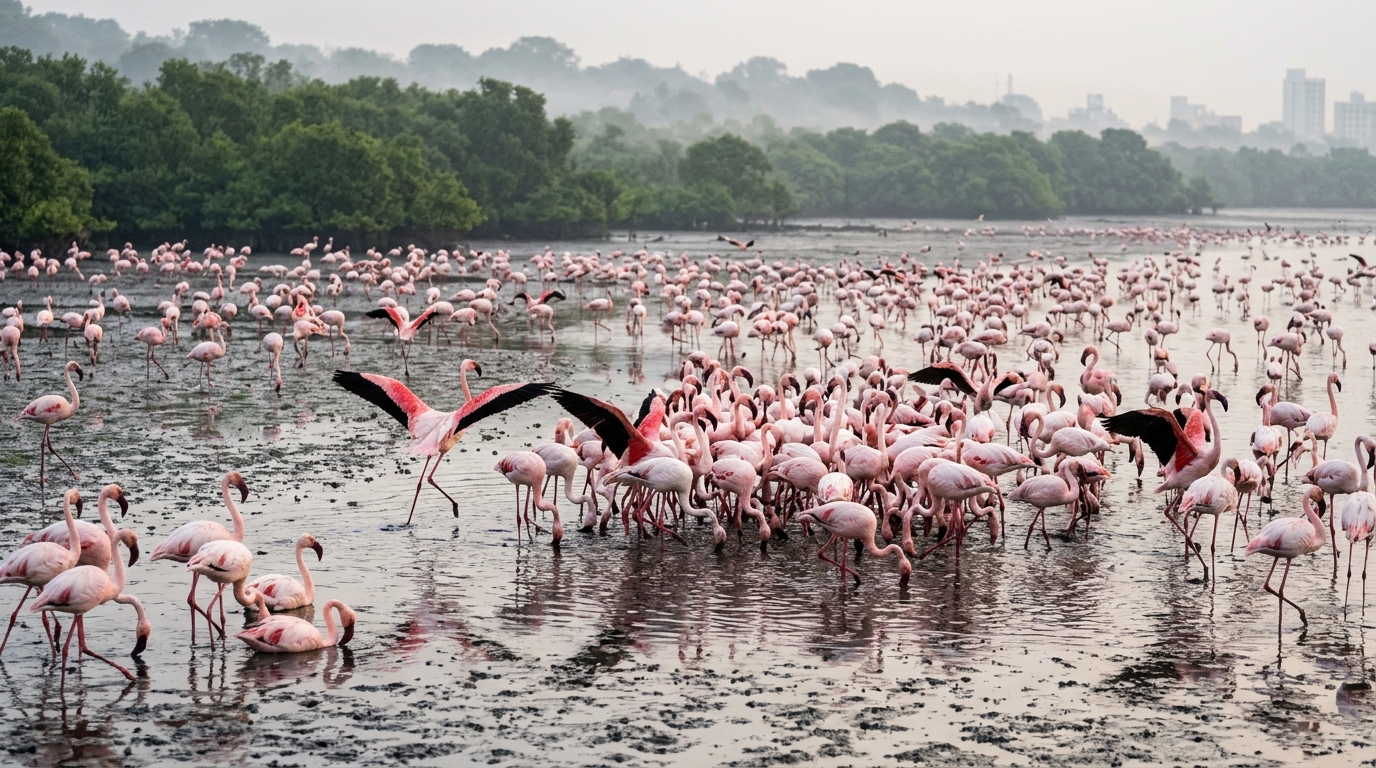
Protecting Crucial Coastal Mudflat Hydrology
Every winter, over 120,000 migratory flamingos travel from breeding grounds in the Rann of Kutch to feast on benthic blue-green algae and microscopic brine crustaceans within the brackish tidal mudflats of Thane Creek.
The sanctuary encompasses extensive contiguous mangrove forests of Avicennia marina and Rhizophora, which serve as vital natural coastal flood buffers for eastern Mumbai and Navi Mumbai.
To monitor bird populations without disturbing delicate feeding behaviors, bioacoustic sensor nodes installed along the mudflats record bird vocalizations 24 hours a day, utilizing machine learning algorithms to estimate flock density and species diversity.
Elevated Eco-Tourism and Citizen Science
A newly completed one-kilometer elevated wooden boardwalk allows schoolchildren and nature enthusiasts to observe tidal wetlands from a respectful distance without trampling fragile pneumatophore mangrove roots.
The facility serves as an educational hub, instilling conservation awareness and demonstrating the critical importance of preserving coastal wetlands alongside expanding urban infrastructure.
Operational Engineering and Metrological Telemetry: Field Metrics
Detailed field investigations conducted across Western Maharashtra reveal that rigorous standardization and telemetry protocols form the operational backbone of this initiative. Modern instrumentation and automated data loggers continuously monitor key operational variables, minimizing human error and providing real-time data feeds to regional command centers.
Under standard operational procedures, field technicians conduct periodic multi-point calibrations against certified reference standards. This continuous measurement feedback loop ensures that environmental, structural, and mechanical tolerances remain strictly within regulatory thresholds established by state monitoring boards.
Statutory Governance, Institutional Audits, and Workforce Compliance
Compliance frameworks governing these operations are strictly aligned with Maharashtra state guidelines and central statutory mandates. Regular third-party technical and environmental audits are performed by accredited engineering agencies to verify structural stability, workplace safety standards, and environmental mitigation protocols.
Furthermore, structured vocational training modules have been established for regional technical personnel, ensuring that operators and supervisory staff are fully qualified to maintain advanced equipment without external dependency. This institutional capacity building represents a critical asset for long-term operational resilience.
Socio-Economic Multipliers and Regional Development Horizons
Beyond immediate operational and infrastructure dividends, the initiative provides substantial economic multipliers for surrounding communities. Local manufacturing workshops, specialized material suppliers, and maintenance technicians experience direct commercial growth through supply-chain formalization.
Community representatives and regional industry associations emphasize that continued state capital investment in these modernized systems fosters long-term civic stability. By bridging traditional craftsmanship with precision engineering, the project establishes a robust benchmark for sustainable regional advancement across Western India.