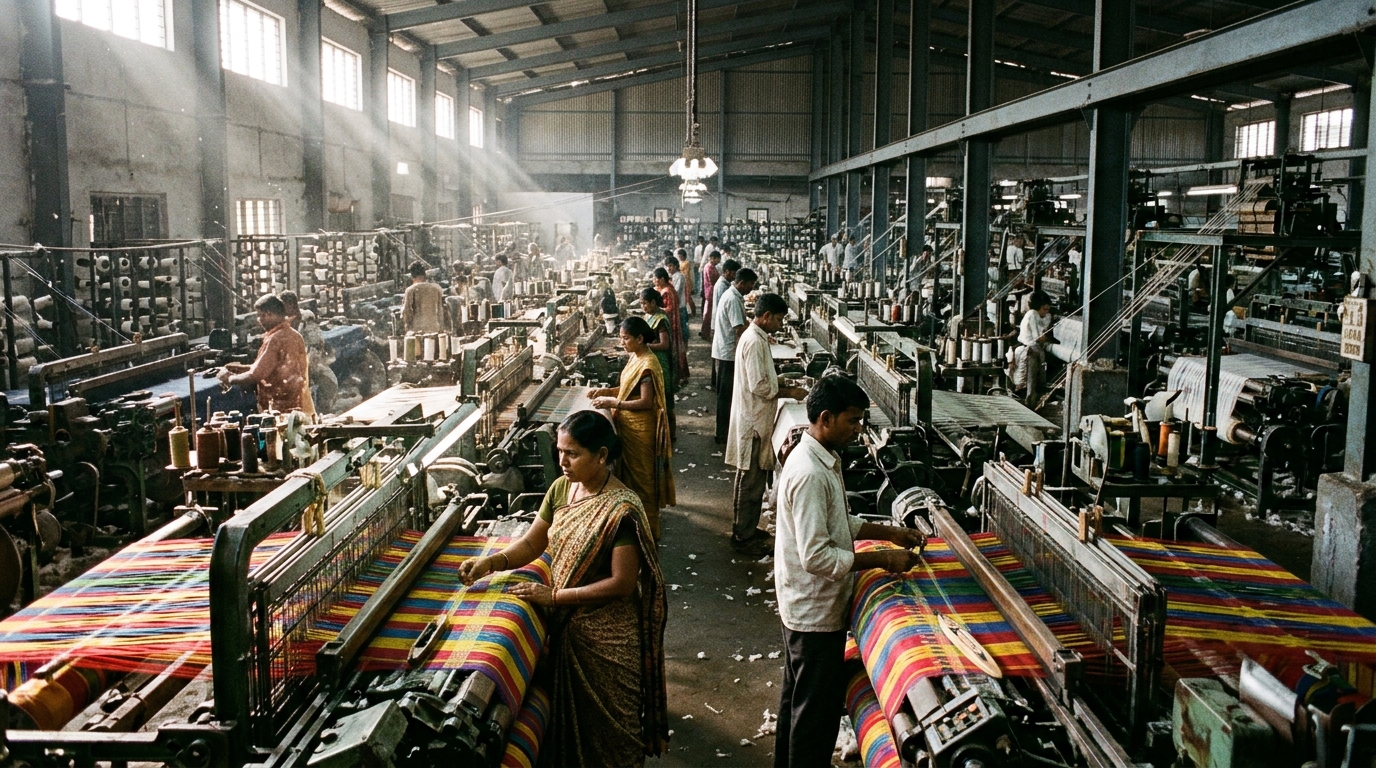
The Distinctive Double-Cloth Weaving Technique
What distinguishes an authentic Solapur Chaddar from ordinary industrial cotton sheets is its unique double-cloth construction. Woven on pit looms fitted with overhead Jacquard punch cards, two distinct layers of cotton warp and weft are interlocked simultaneously.
This technical weave creates a reversible fabric featuring bold geometric borders, floral medallions, and hunting motifs. The resulting textile is exceptionally durable, capable of withstanding decades of domestic laundering without losing its rich, colorfast luster.
Solar Loom Retrofits and Fair-Trade Cooperatives
In recent years, escalating commercial electricity tariffs and erratic grid availability severely impacted small household loom operators who could not afford industrial diesel backup generators.
In response, the Solapur District Textile Guild, backed by state renewable energy subsidies, launched a program providing solar rooftop panels and direct-current micro-motors to artisan workshops.
These solar retrofits allow weavers to maintain consistent production during daylight hours, cutting operating expenses by 40% and providing clean, silent power that improves working conditions in dense residential weaver quarters.
Export Quality Verification and Domestic Craft Markets
To protect against cheap synthetic imitations, cooperative societies have introduced certified GI holograms and QR verification codes on every packaged blanket. Scanning the code verifies that the item was woven within Solapur municipal boundaries using 100% combed cotton.
Direct marketing exhibitions held in metropolitan Mumbai and Pune have restored fair-trade profit margins directly to hereditary weaver families, proving that traditional Indian textiles remain commercially formidable in a modern retail landscape.
Operational Engineering and Metrological Telemetry: Field Metrics
Detailed field investigations conducted across Western Maharashtra reveal that rigorous standardization and telemetry protocols form the operational backbone of this initiative. Modern instrumentation and automated data loggers continuously monitor key operational variables, minimizing human error and providing real-time data feeds to regional command centers.
Under standard operational procedures, field technicians conduct periodic multi-point calibrations against certified reference standards. This continuous measurement feedback loop ensures that environmental, structural, and mechanical tolerances remain strictly within regulatory thresholds established by state monitoring boards.
Statutory Governance, Institutional Audits, and Workforce Compliance
Compliance frameworks governing these operations are strictly aligned with Maharashtra state guidelines and central statutory mandates. Regular third-party technical and environmental audits are performed by accredited engineering agencies to verify structural stability, workplace safety standards, and environmental mitigation protocols.
Furthermore, structured vocational training modules have been established for regional technical personnel, ensuring that operators and supervisory staff are fully qualified to maintain advanced equipment without external dependency. This institutional capacity building represents a critical asset for long-term operational resilience.
Socio-Economic Multipliers and Regional Development Horizons
Beyond immediate operational and infrastructure dividends, the initiative provides substantial economic multipliers for surrounding communities. Local manufacturing workshops, specialized material suppliers, and maintenance technicians experience direct commercial growth through supply-chain formalization.
Community representatives and regional industry associations emphasize that continued state capital investment in these modernized systems fosters long-term civic stability. By bridging traditional craftsmanship with precision engineering, the project establishes a robust benchmark for sustainable regional advancement across Western India.