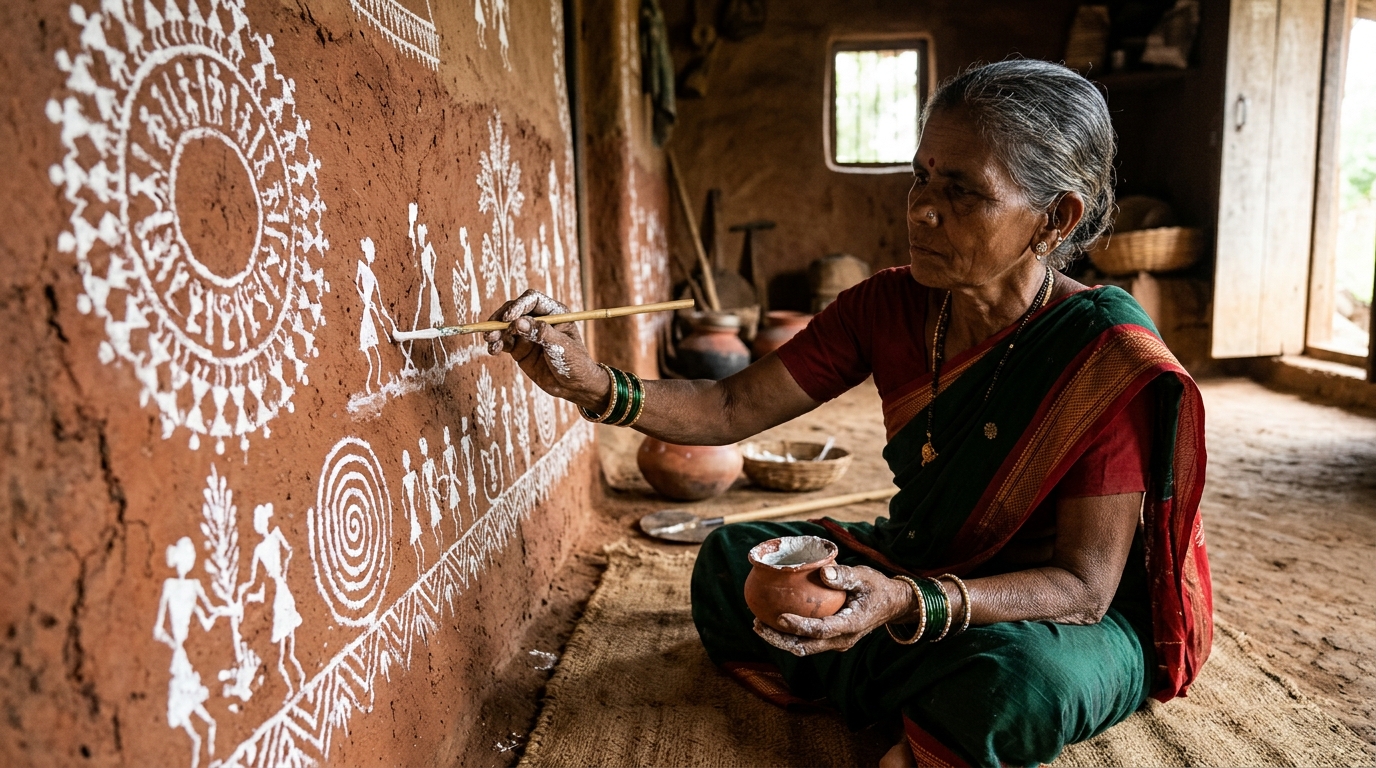
Minimalist White Rice Pigments and Symbolic Geometries
Warli paintings, practiced since at least the 10th century CE, are traditionally painted by women ('Suhasinis') on the earthen walls of rural huts during harvest and wedding festivals.
The painting surface is prepared with red mud and cow dung, while the paint itself consists purely of pounded white rice flour mixed with water and natural gum. Using chewed bamboo twigs as delicate brushes, artists draw fundamental geometric shapes: circles representing the sun and moon, triangles denoting mountains and trees, and squares symbolizing sacred sacred enclosures ('Chauk').
The iconic 'Tarpa dance' motif, where dancers interlock hands in expanding concentric spirals, represents the cyclic nature of agricultural life and cosmic time.
Artisan Guilds and Protection Against Mass Commercial Counterfeiting
With the granting of Geographical Indication (GI) status, Warli tribal cooperatives in Dahanu and Jawhar have established community craft hubs.
Certified artworks carry official hand-printed holographic seal tags, ensuring that national art galleries and international collectors purchase authentic, fair-trade pieces created by recognized tribal masters.
Operational Engineering and Metrological Telemetry: Field Metrics
Detailed field investigations conducted across Western Maharashtra reveal that rigorous standardization and telemetry protocols form the operational backbone of this initiative. Modern instrumentation and automated data loggers continuously monitor key operational variables, minimizing human error and providing real-time data feeds to regional command centers.
Under standard operational procedures, field technicians conduct periodic multi-point calibrations against certified reference standards. This continuous measurement feedback loop ensures that environmental, structural, and mechanical tolerances remain strictly within regulatory thresholds established by state monitoring boards.
Statutory Governance, Institutional Audits, and Workforce Compliance
Compliance frameworks governing these operations are strictly aligned with Maharashtra state guidelines and central statutory mandates. Regular third-party technical and environmental audits are performed by accredited engineering agencies to verify structural stability, workplace safety standards, and environmental mitigation protocols.
Furthermore, structured vocational training modules have been established for regional technical personnel, ensuring that operators and supervisory staff are fully qualified to maintain advanced equipment without external dependency. This institutional capacity building represents a critical asset for long-term operational resilience.
Socio-Economic Multipliers and Regional Development Horizons
Beyond immediate operational and infrastructure dividends, the initiative provides substantial economic multipliers for surrounding communities. Local manufacturing workshops, specialized material suppliers, and maintenance technicians experience direct commercial growth through supply-chain formalization.
Community representatives and regional industry associations emphasize that continued state capital investment in these modernized systems fosters long-term civic stability. By bridging traditional craftsmanship with precision engineering, the project establishes a robust benchmark for sustainable regional advancement across Western India.